
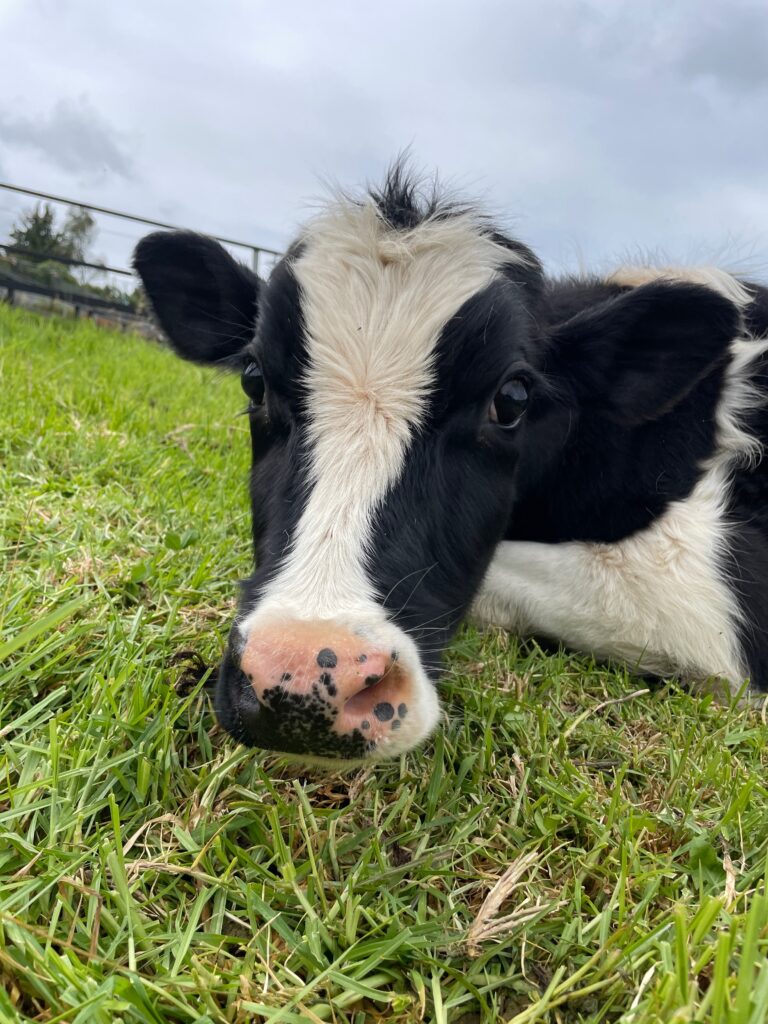
I will never forget the day the government called us. They asked whether we could take in a calf who had only three legs.
Forrest was born on a dairy farm. When he was just a baby, he refused to climb onto the truck that would take him to slaughter. All he wanted was to stay with his mother. Because he resisted, the farmer cut off one of his back legs.
When the truck reached the sanctuary, I climbed in to help him down and saw a group of llamas in the back. One of them had a deformity in his mouth. I asked what would happen to him, and they told me he had also been rescued, but nobody wanted to adopt him because of the way he looked. I asked them to let him off too. That was the day Forrest became part of our family, and without even knowing it, he brought Gojo home with him.

To understand Forrest’s story, you need to know where he came from. A cow only produces milk after she gives birth. If her baby is female, she may spend years being exploited so her milk can feed humans. If her baby is male, he will never produce milk, so to those who profit from cows he is worth very little. Many male calves are killed before they are even eight days old.
There is even a term in the scientific literature for the calves who are not needed to replace the cows used for milk: “surplus calves.” I hate that term. No living being is surplus. But it tells us a lot about how these babies are seen. A review published in Frontiers in Veterinary Science explains that their low economic value can also affect the care they receive. Researchers have documented problems with colostrum feeding, nutrition, transport at very young ages, disease, and death.
This does not only happen in other countries. Here in Colombia, Bogotá’s District Institute for Animal Protection and Welfare has written about the male calves born on dairy farms. The Institute explains that they have little commercial value for meat and that raising them is seen as an expense, as if they were products and not babies.
Another reality of cow’s milk production is the separation of mothers from their calves, often shortly after birth. Researchers have studied its effects for years and have documented the calls and changes in behavior that follow. Calves are social beings, and contact with their mothers and with other animals matters deeply to them.
As a vegan, I believe there is a deeper question: why should we be the ones who decide when a mother can be with her baby?
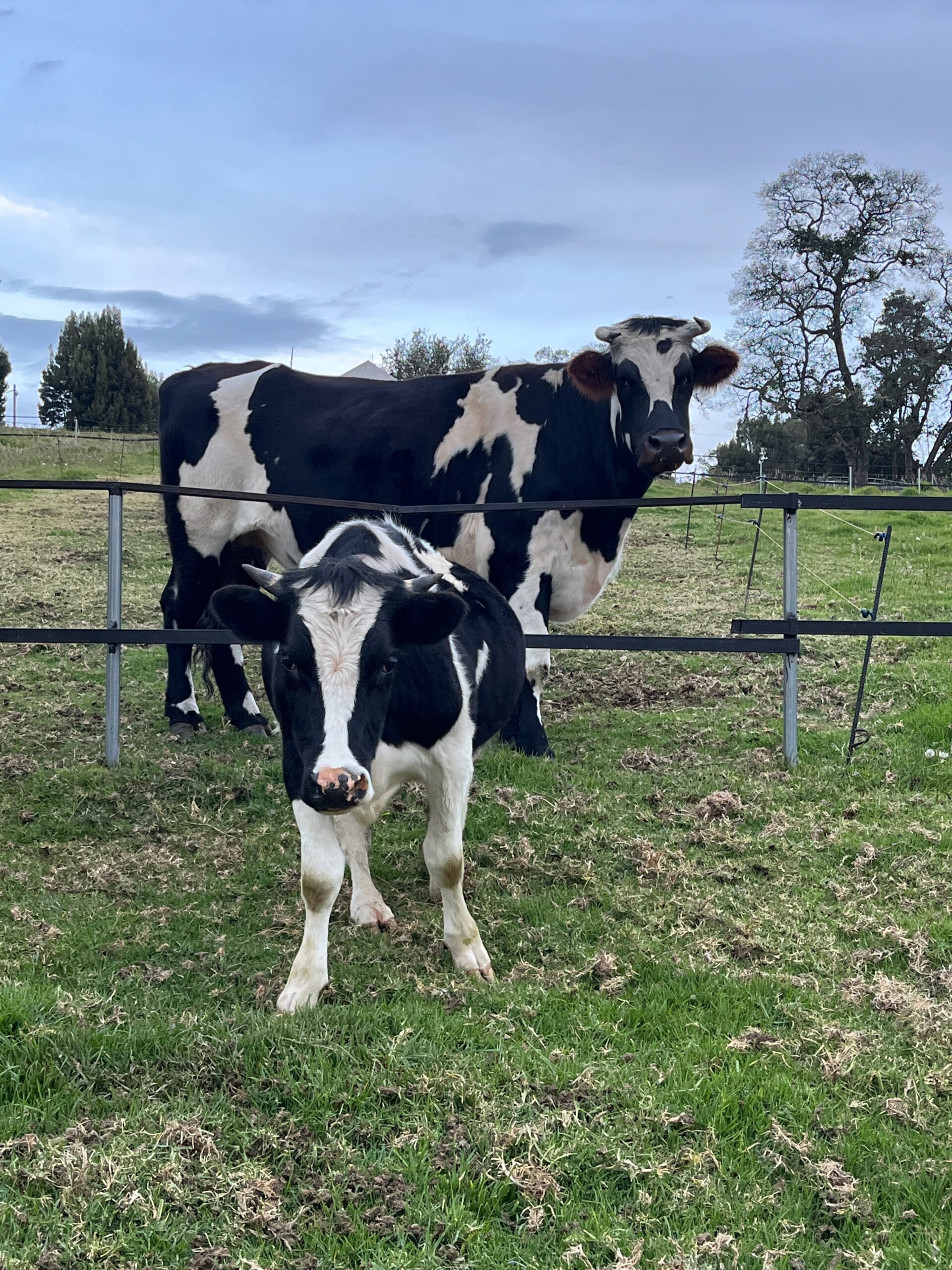
I think of Balaram. His mother belonged to a dairy farm. When she was about to give birth, she jumped over a fence and had her baby on our side. I helped bring Balaram into the world right there on the grass, and in the end we were allowed to keep him. His mother had to go back to the farm.
Balaram was safe from his very first day. Forrest was not that lucky. From the day he arrived on three legs, he did everything he could to keep going. We tried three times to fit him with a prosthetic leg: two we bought in the United States and one in Colombia. On our last attempt, a company promised follow up care and visits that never came, and things got worse. Over time, his front legs settled into a position we could no longer correct.
We built a special area so he could move more easily, we searched for alternatives, and we never stopped trying. But eventually he developed pain that we could no longer control.
Forrest was one of the sweetest bulls I have ever known. His eyes were full of tenderness, and his patience seemed endless. In the end, he could not even walk to the water, and we had to accept that continuing to try was no longer helping him. I would have given him my own leg if it could have helped. I said it the day he died, and I still mean it.
Forrest left us on a Monday, at home, with the help of our veterinarians. He was surrounded by his caregivers, his family, and Bhimal, his human brother. I held his head in my lap while we listened to mantras, and my tears fell on him.
After more than twenty years of rescuing animals, I have learned how much they enjoy simply being alive. I have watched bulls run, play, look for their friends, rest in the sunshine, and choose where they want to spend their day.
Today Balaram has been able to do what I so deeply wanted for Forrest: grow old. When I see him, old and at peace at the sanctuary, I think of all the years he has lived simply being himself. That is what I wanted for Forrest. I wanted to watch him grow old. I wanted him to run and enjoy his freedom for many more years.
When I think about Forrest, I feel sadness, but I also feel anger. It is so easy to look at a glass of milk or a piece of cheese without thinking about everything that happened before it reached us. A cow was made pregnant. A baby was born. And if that baby was male, his life was considered almost worthless, simply because he would never produce milk.
I knew one of those calves. I knew his personality, his friends, the things he loved, and how much he wanted to live. I used to call him our cucaracho, after the song about the little cockroach who cannot walk because he is missing a leg. He was family.
Forrest deserved to have all four legs. He deserved to run, and he deserved to grow old, just like Balaram.
We will miss you terribly, Forrest. We will keep educating people so this never happens again, and no one will silence our voice. For you, my dear Forrest, and for all the victims the world chooses to ignore.
Go vegan.

